
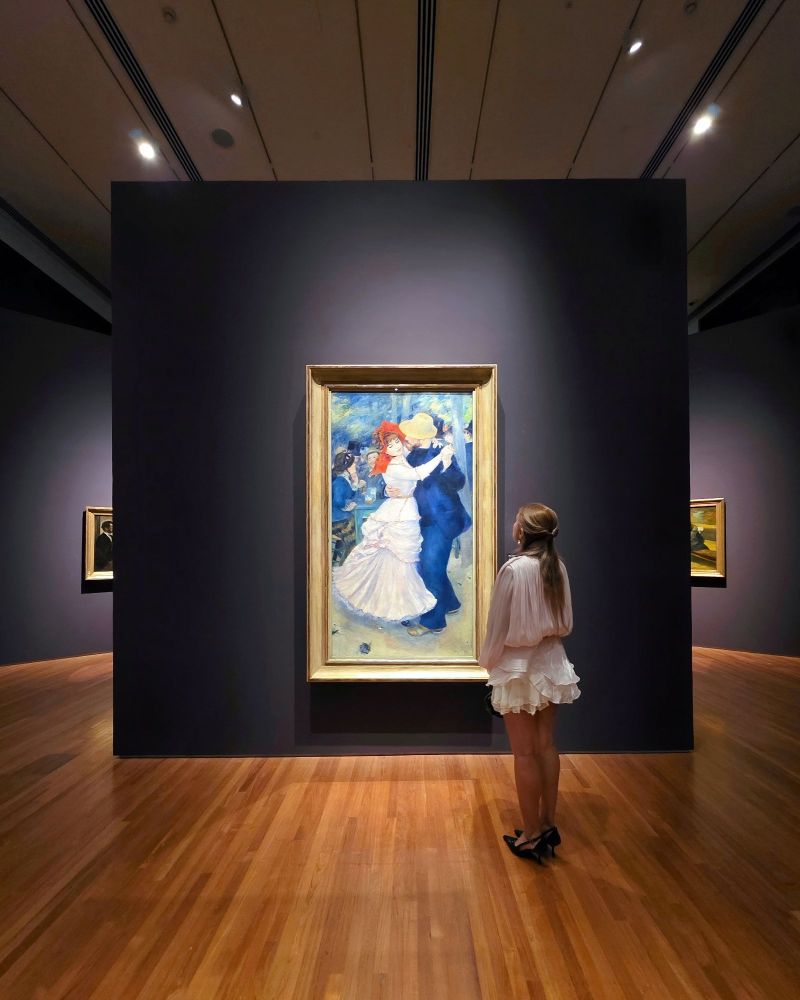
Visit the largest French Impressionist exhibition in Southeast Asia never before exhibited in Singapore. Developed by the Museum of Fine Arts Boston in collaboration with National Gallery Singapore, don’t miss the opportunity to witness these legendary artworks up close.
The term “Impressionist” was first applied to artists in 19th century France who used loose, sketchy brushwork to paint moments form everyday life. Controversial when they were first exhibited, works by artists like Claude Monet, Pierre-Auguste Renoir and Edgar Degas have now become iconic. Beyond their beauty, Impressionist works captured the beginnings of modernity in ways that still speak to us today. Featured here are some of my favourites.
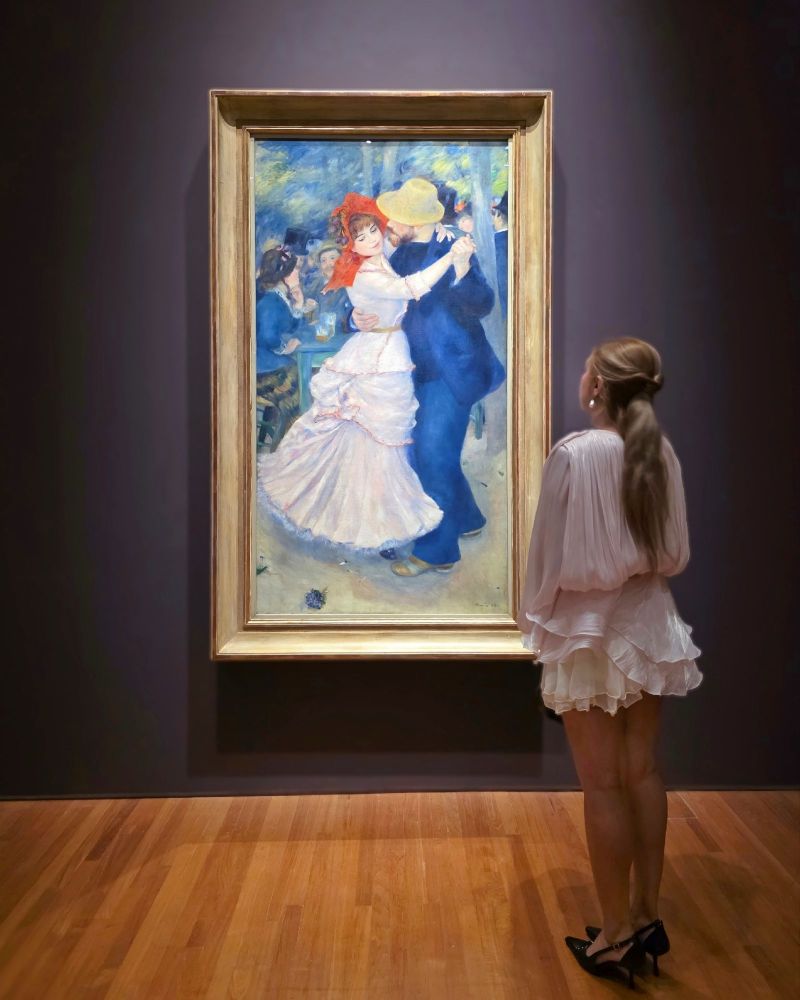

Table of Content

Dance at Bougival
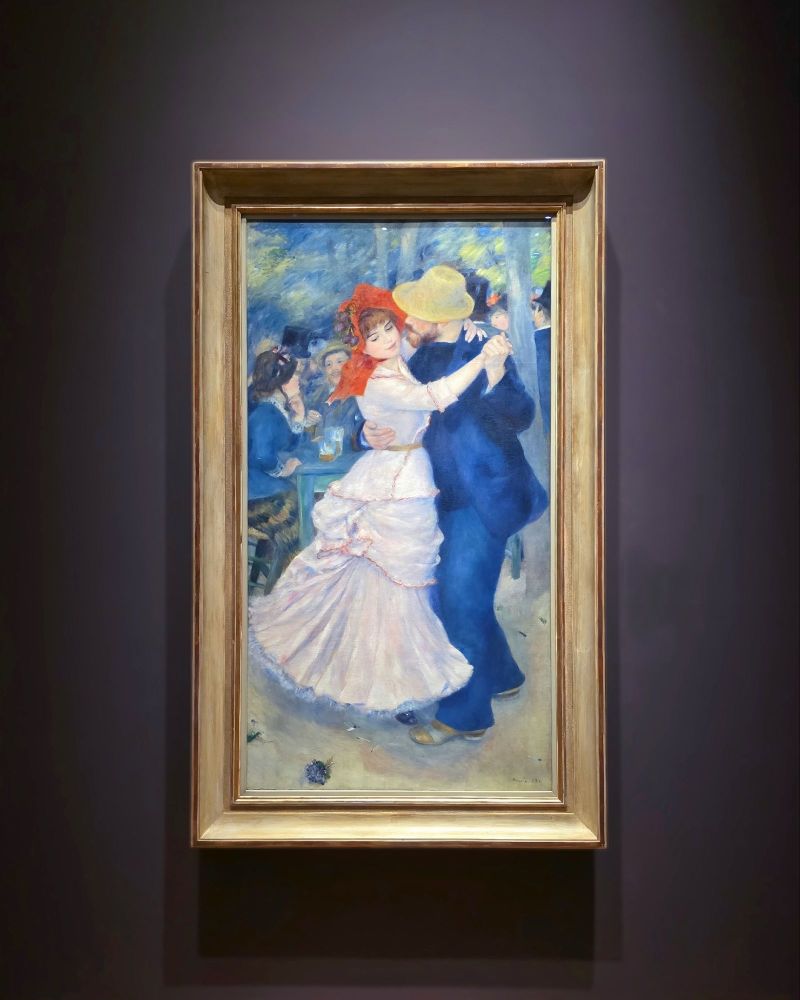
Pierre-Auguste Renoir
1883, Oil on Canvas
The open-air cafés of suburban Bougival, a town on the river Seine west of Paris, were popular recreation spots for city dwellers, including the Impressionists. Here, at one such café – its floor littered with cigarettes, burnt matches, and a small bouquet of flowers – an amateur boatman in a straw hat sweeps his stylish partner along in a waltz. The touch of their gloveless hands, their flushed cheeks and intimate proximity, suggest a sensuous subtext to this scene. The son of a dressmaker and a tailor, Renoir delighted in capturing intricate details of contemporary fashions, such as the woman’s red bonnet trimmed with purple fruits.
Girls Picking Flowers in a Meadow
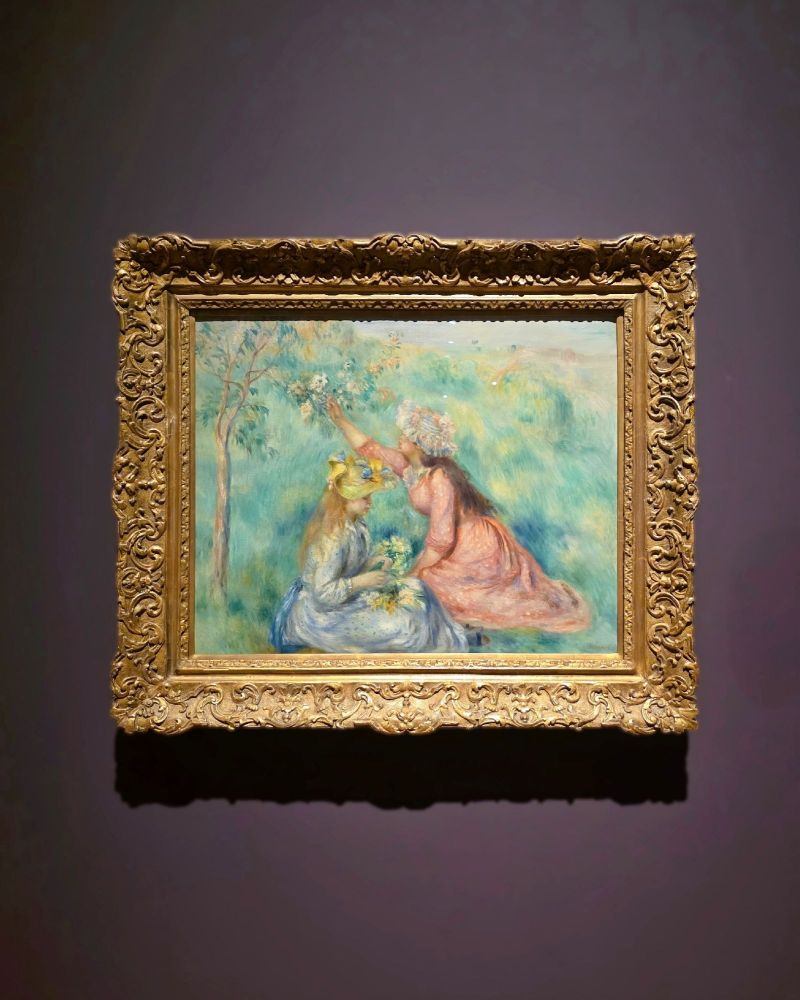
Pierre-Auguste Renoir
about 1890, Oil on Canvas
Renoir spent the summer of 1890 at the country house of fellow Impressionist Berthe Morisot and her husband Eugène Manet, Edouard Manet’s brother. Renoir asked their daughter, Julie, to pose for him, along with her fair-haired cousin, Jeanne Gobillard. Renoir gives the girls – their bonnets elaborately ruffled and ribboned – the fanciful air of shepherdesses in a rococo pastoral, taking his cue from the 18th-century artist François Boucher and his airy, make-believe scenes. With its flowering sapling at left, the picture also reads as an allegory of budding maturity.
Carmen Gaudin in the Artist’s Studio
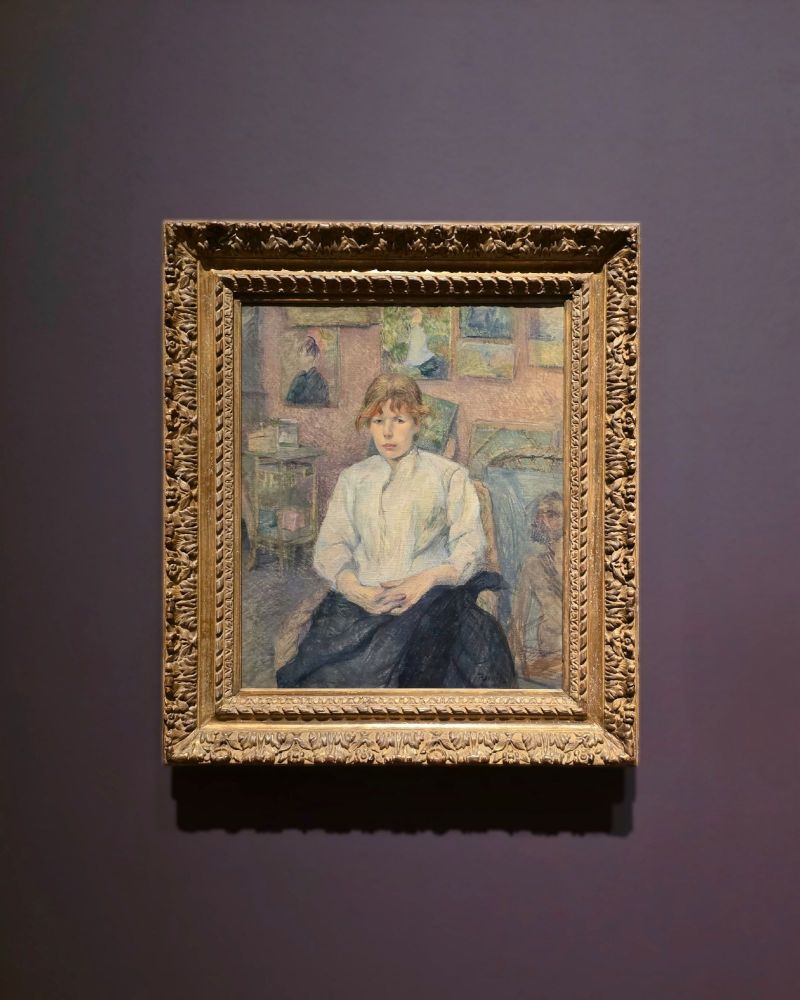
Henri de Toulouse-Lautrec
1888, Oil on Canvas
Toulouse-Lautrec met red-haired Carmen Gaudin in the Montmartre district of Paris in 1884, and she soon became his favorite model. Here, Gaudin wears the white blouse of a laundress and sits before a studio wall covered with angular canvases. Work-roughened fingers laced in her lap, she stares out at the viewer with a withdrawn, even sullen, expression. The life of a professional model was difficult and fraught with social stigma, her employment dependent on whether her look fit an artist’s vision. When Gaudin changed her locks from red to brown, Toulouse-Lautrec no longer hired her.
Mixed Flowers in an Earthenware Pot
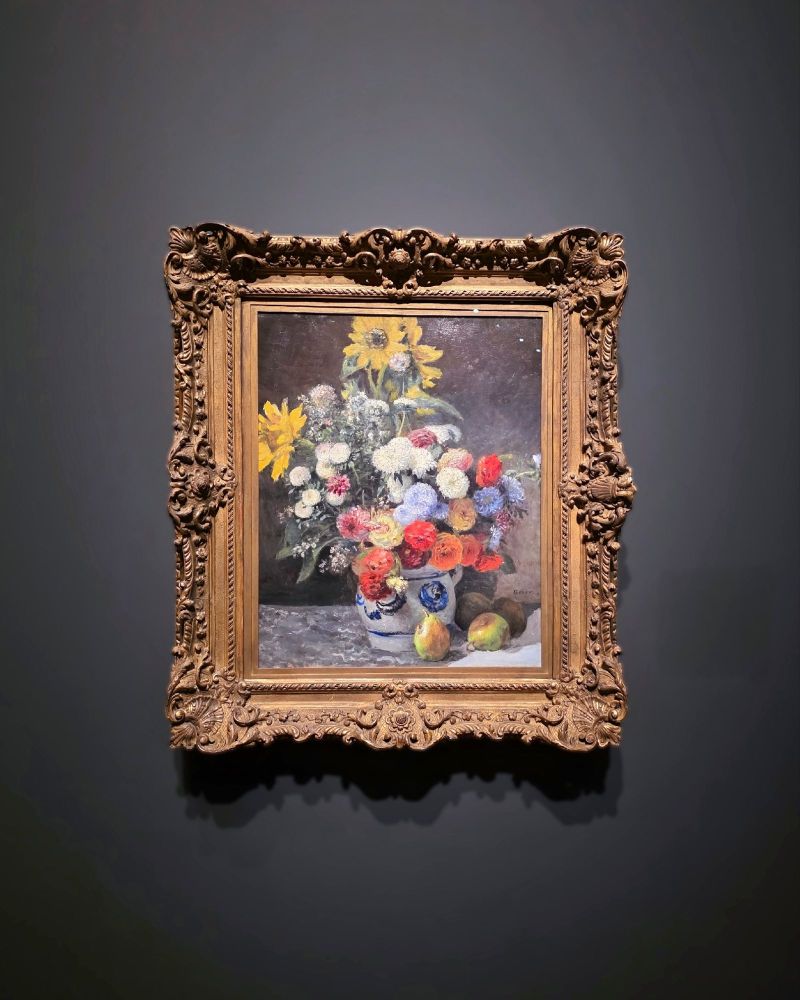
Pierre-Auguste Renoir
about 1869, Oil on Canvas
In this rustic arrangement of dahlias, asters, and sunflowers, Renoir applied paint in two different ways, conveying the delicacy of petals with short, wet strokes and the solidity of the earthenware pot and burnished pears with broader, smoother brushwork. The picture marks Renoir’s closest collaboration with Monet; the young artists painted the same still life, sitting side by side before the arrangement. Monet’s version of the composition is now in the J. Paul Getty Museum.
Fruit and a Jug on a Table
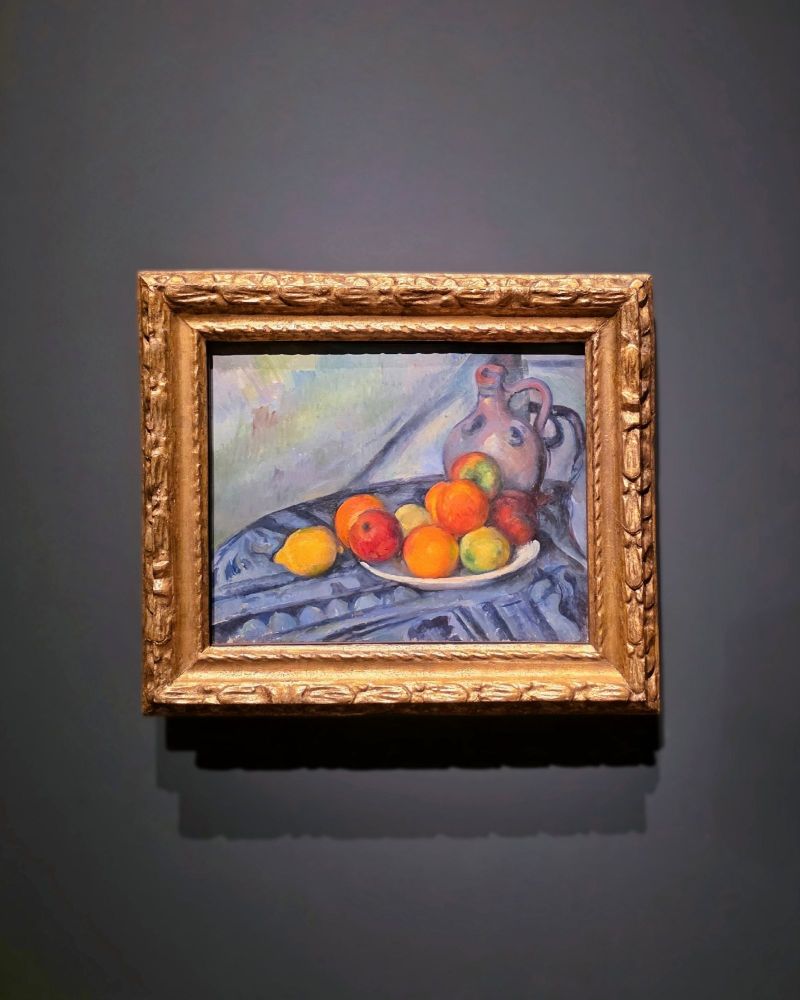
Paul Cézanne
about 1890-94, Oil on Canvas
“I want to astonish Paris with an apple”, said Cézanne, who lived and worked in Provence for much of his career. While he relished the quiet solitude of the south, he maintained contact with the art capital, sending paintings (including this one) to Paris for exhibition and sale. Cézanne once explained his fascination with painting fruits, “They love having their portraits done. They sit there as if demanding pardon for changing color. They come to you in all their perfume, speaking of the fields they have left, the rain that has nourished them, the sunrises they have seen.”
Grapes and Walnuts on a Table
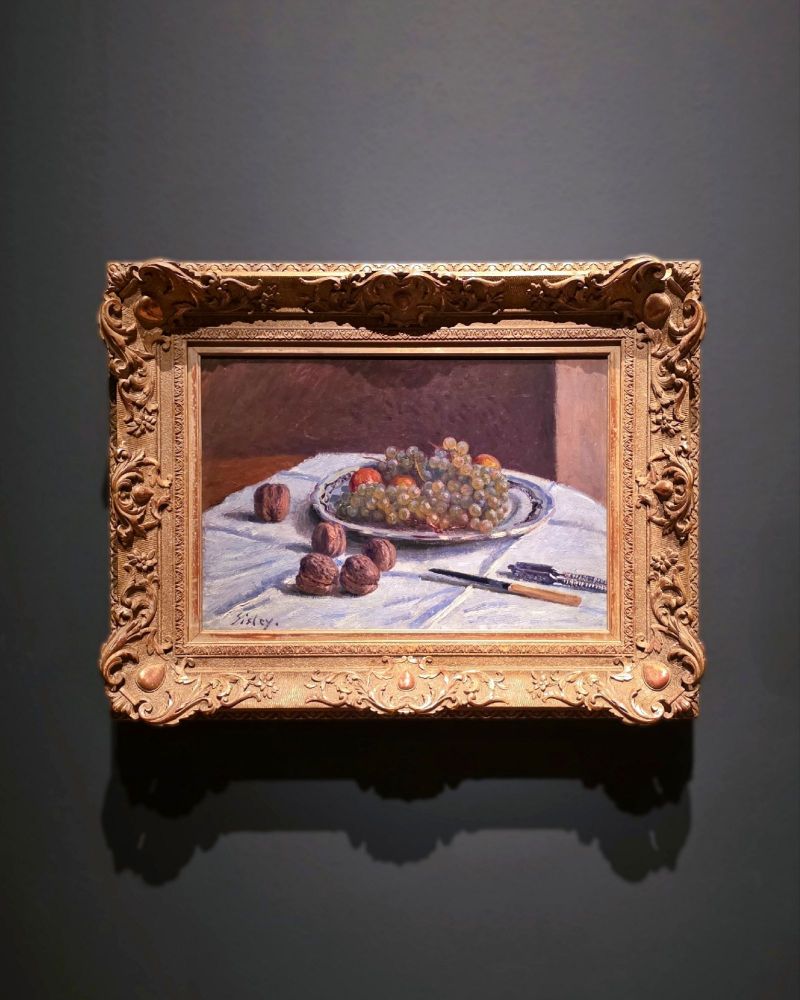
Alfred Sisley
about 1876, Oil on Canvas
It was likely at Monet’s suggestion that Sisley undertook this still life – one of just nine he ever painted. With its inventory of fruit, plate, walnuts, knife, and nutcracker, the modest composition exhibits all the hallmarks of an Impressionist picture, painted from life and in natural light. Ranged across the snowy expanse of the tablecloth – its topography of creases rendered with brisk strokes of blue and white – these objects almost take on the character of a landscape, Sisley’s more accustomed genre.
The Water Lily Pond
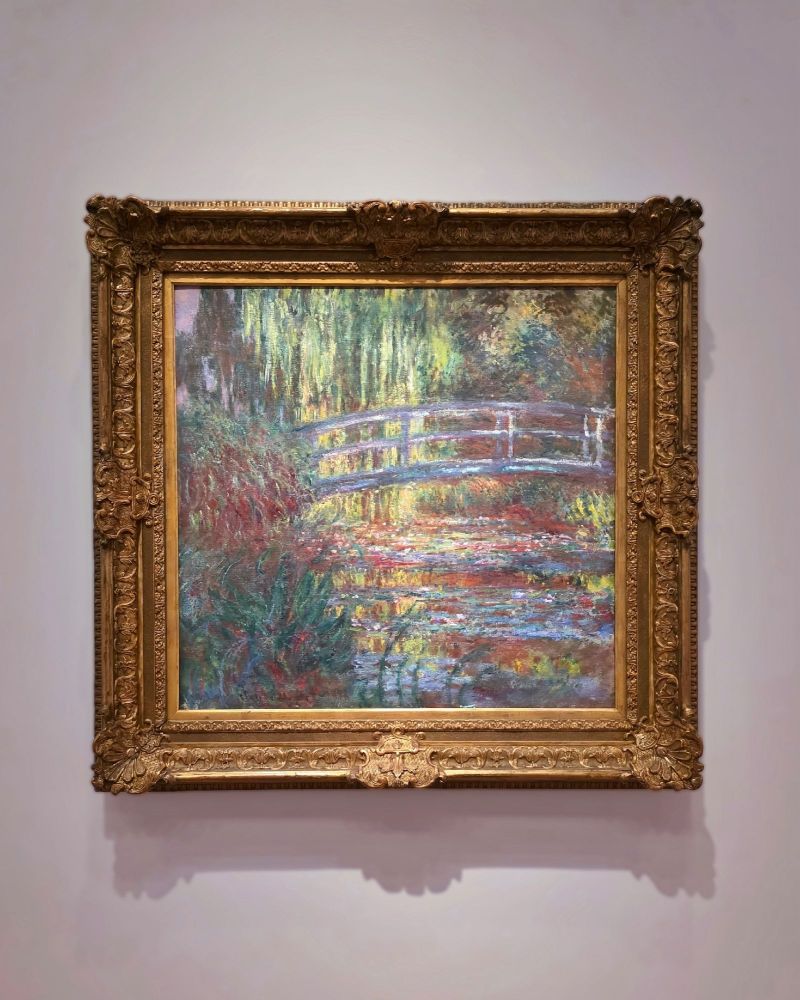
Claude Monet
about 1900, Oil on Canvas
In 1883, Monet settled in the village of Giverny, about forty miles from Paris, and purchased a house there in 1890. Shortly thereafter, he acquired an additional plot of land, where he constructed a picturesque water garden. A Japanese bridge spanned the pond at its narrowest point. This is among the first of Monet’s paintings to emphasize the reflections of the bank and the sky on the flat surface of the water.
Cap Martin, near Menton

Claude Monet
about 1884, Oil on Canvas
This picture belongs to a group Monet painted on the French Riviera in April 1884. We stand on the eastern side of the cape, looking across the bay towards the Maritime Alps. Monet was drawn back to the Mediterranean coast, which he had visited with Renoir the previous December, for the intensity of its light. To suggest the sky’s airy expanse, he left much of the upper portion in reserve, indicating the contours of cloud and mountain with a few sketchy strokes.
Road at La Cavée, Pourville
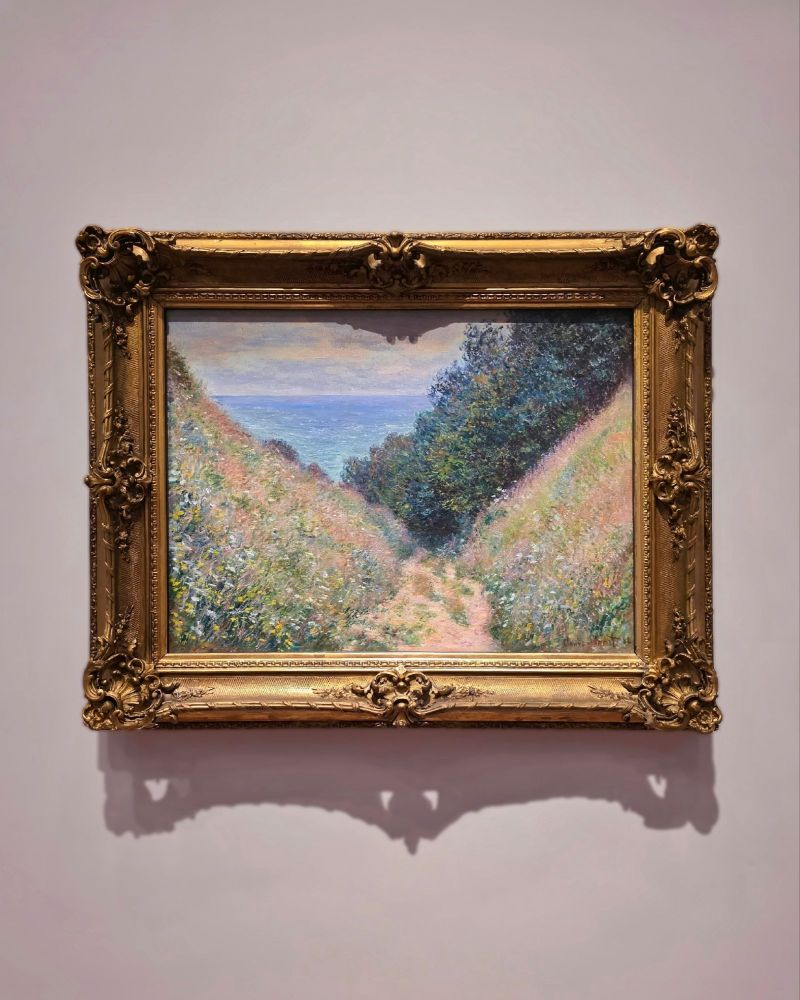
Claude Monet
about 1882, Oil on Canvas
Monet had begun to experiment with X-shaped compositions as early as 1863-64. Here, almost twenty years later, he has refined the schema and simultaneously clothed it in an active surface pattern of indescribable subtlety. Despite the uncertain continuance of the path, this is a welcoming, pleasant place. The path nestles between two soft mounds. In the Western tradition, landforms are often discussed in sensuous terms in relation to the human body. By this date Monet’s paintings only rarely included the human figure. If one were present here, the scene would take on an anecdotal air, and the force of the geometry and suggestiveness of the landscape would be diminished. Without a figure, this painting invites, seduces, comforts, and promises, on an optical as well as an animal level, the component parts of which are impossible to disentangle.
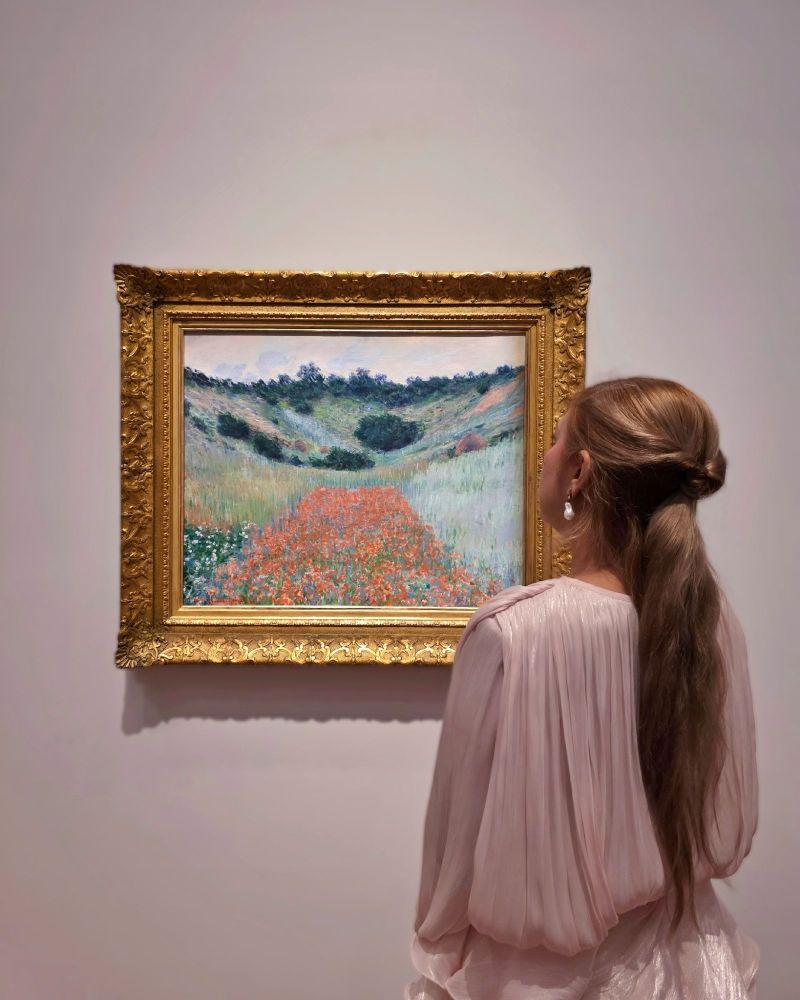
Poppy Field in a Hollow near Giverny
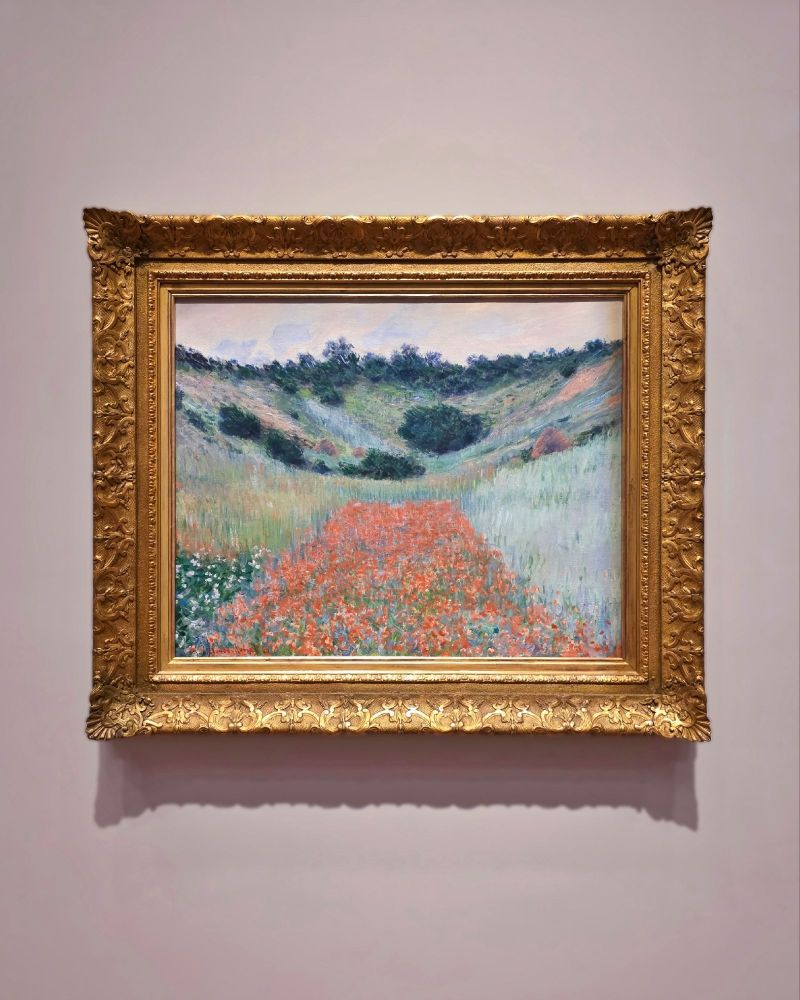
Claude Monet
about 1885, Oil on Canvas
Monet and his fellow Impressionists believed that art should express its own time and place and that it should do so in an appropriately modern style. In the 1860s and 1870s, working primarily outdoors, the Impressionists observed that objects seen in strong light lose definition and appear to blend into one another. No clear outlines exist in this sunny landscape. Its forms and textures are suggested by the size, shape, and direction of the brushstrokes, and the juxtaposition of complementary reds and greens gives the painting a vibrant intensity. By the mid-1880s, most members of the original group had turned away from Impressionism, but Monet declared, “I am still an Impressionist and will always remain one.”

Join the list!
Subscribe for the latest exclusive updates delivered to your inbox.
Things to Note
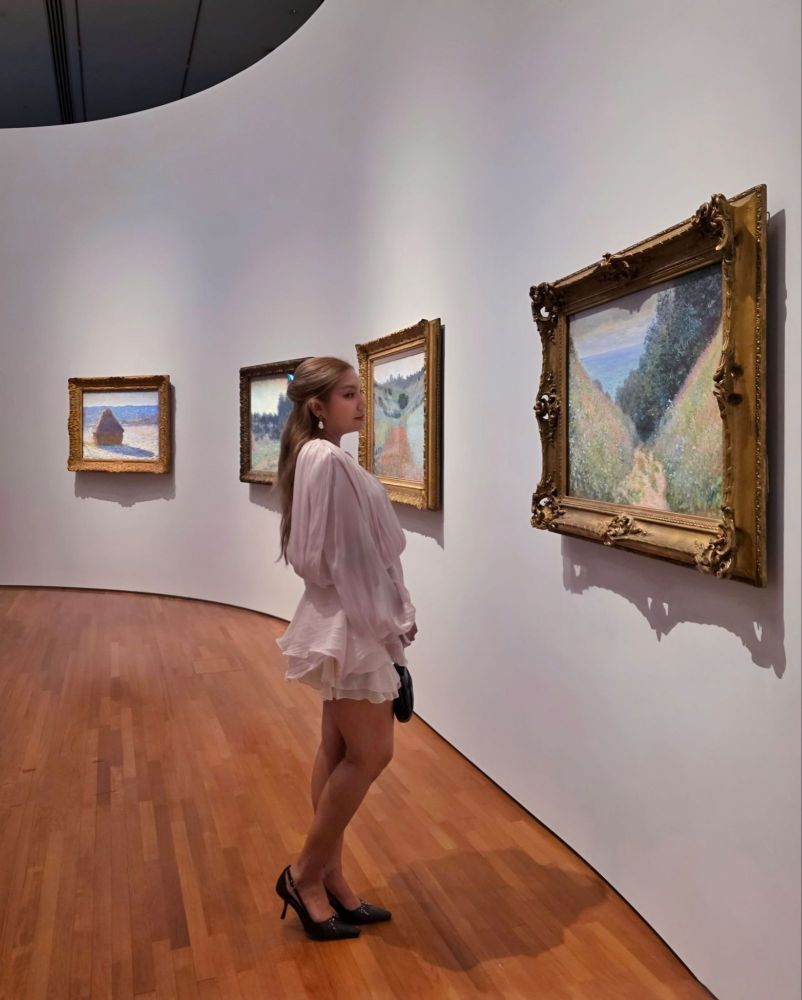
- Into the Modern: Impressionism from the Museum of Fine Arts, Boston is drawing large crowds especially on weekends. Hence, weekend entry is on a first come, first served basis, with timed admission slots.
- Entry slots are available every 30 minutes from 10am to 6pm. Arrive early to secure your preferred time slot, as availability may fill up quickly.
- Buy your tickets at Visitor Services Counter or ticketing kiosks at Coleman Street. Klook discount code is only applicable on the Klook platform.
- Guided Tours are available in English (Wed-Fri, 11am and 3pm) and Mandarin (Thurs and Fri, 2pm).
- Into the Modern: Impressionism from the Museum of Fine Arts, Boston Exhibition Catalogue and Booklet are available for purchase.
- There are clear explanations next to each artwork so you may not need a guide book or guided tour if you would like to take your time.
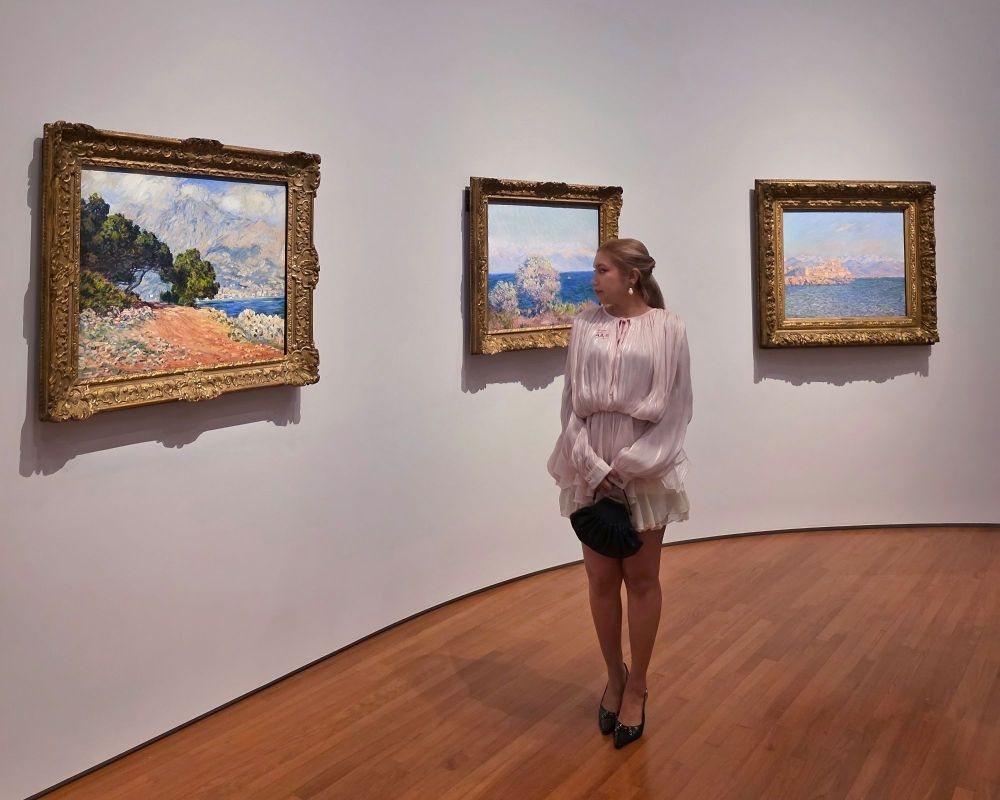
I’ve always had love for Impressionist art for its whimsy. As cliche as it is, Claude Monet’s Water Lily Pond was one of my first introduction to modern art so it holds a special place. Never thought I’ll see it in person and here in Singapore. Hope to be able to see the garden this piece was drawn after one day, but for now, I’m grateful to get this experience ticked off the bucket list.
Admission Charges
Local Residents
Adult: $11.25
Child (7-12 years old): $11.25
Senior (Above 60 years old): $7.50
Full Time National Servicemen: $7.50
Student & Teachers (based in Singapore): Free
PWD & Caregiver: Free
Standard
Adult: $18.75
Child (7-12 years old): $15
Senior (Above 60 years old): $15
Student & Teachers (overseas): $15
Address:
National Gallery Singapore, 1 St Andrew’s Road, Singapore 178957
Opening Hours:
10:00 – 19:00 (Daily)

Pin This:
Related Posts:

Must-See Masterpieces at the Prado Museum
Photo from TripAdvior The Prado Museum is the cultural jewel of Spain and is a must-visit while in Madrid. It is considered one of the greatest art museums in the world and…
Must-See Objects at the British Museum
As a museum enthusiast, visiting the British Museum was high on my list. But with over 8 million historical artefacts and more than 60 galleries, it’s nearly impossible to see…
MINT Museum of Toys Singapore
Photo from Singapore Tourism Board Tucked in between Seah Street, stands the MINT Museum of Toys, the only vintage toy museum in Singapore and the largest in Asia! Definitely not…
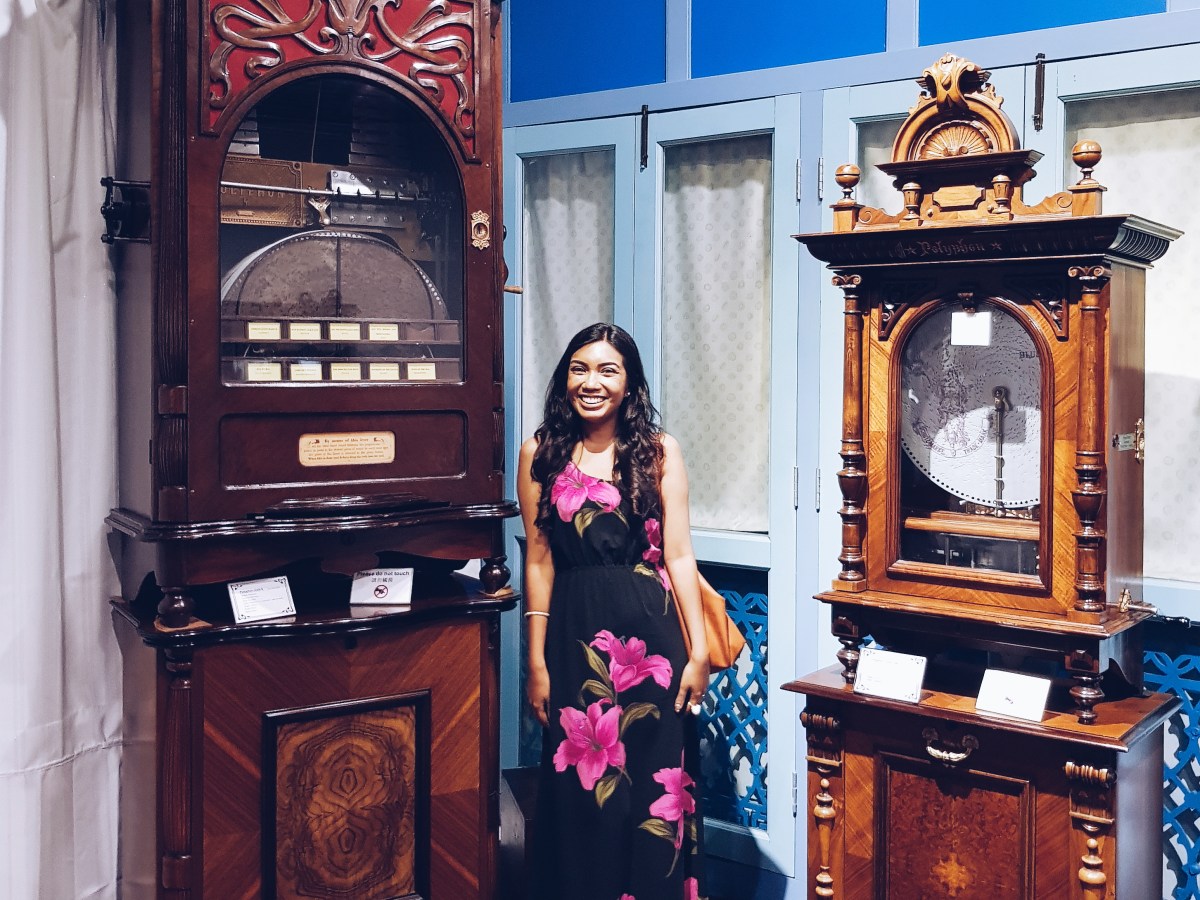
Singapore Musical Box Museum
Some weeks ago after my tour of Chinatown, I was looking for a quiet place to have a cup of tea when I stumbled upon a space just beside the…
Reference:
National Gallery Singapore
Museum of Fine Arts, Boston














 Love Bella Vida